

THIS ARTICLE COVERS:
Canapés
Corporate Christmas Parties
Corporate Entertaining
Engagement Parties
End of Year Events
Event Planning
Private Event Venues
Private Events
Shared Dining
At Home Events
Private Chef
Birthday Catering
Private chef and catering services solve this, but a lot of first-time hosts aren't sure what they actually need to organise versus what the caterer handles. Here's the checklist we run through with clients planning a private dinner party or home celebration in Brisbane.
A rough guest count
Important no matter where your event is being hosted! A quick note that's important for private events, our packages start from 20 guests. Planning something more intimate than that? We're happy to recommend a specific private chef better suited to smaller occasions - just ask.
Your kitchen setup
Oven size, bench space and available fridge space all affect what's realistic to prepare on-site versus off-site. If you think your kitchen isn't quite up to the job, don't worry. As a full-service caterer, we're equipped to work in a range of spaces and can bring our own cooking equipment, ovens, hot plates, prep tables etc.., where needed.
Fridge space before we arrive
One of the most overlooked parts of preparing your home for catering: making room in your fridge (extra points if you have a second fridge available) for food to go into ahead of preparation. You'd be surprised how many separate components (and thus, separate trays / containers) go into making just one of your chosen menu items.
The vibe, not just the menu
Formal seated dinner or relaxed shared-plate style? This shapes staffing more than the food itself does.
Dietary requirements (including children and plus ones)
Even a partial list is a useful starting point and it's worth capturing everyone attending, not just the guests on the original invite.
One honest note here: while our kitchen team is often able to accommodate last-minute dietary requests on the day, we're not a restaurant and can only work with what we've brought based on the agreed menu. If you've chosen a meat-heavy menu and a vegan friend shows up unannounced, there's only so much we can do for them on the spot.
Rubbish and disposal arrangements
Let us know whether catering waste can be disposed of on-site or needs to be taken away with us. Having this sorted in advance means our team can clean as they go, keep the service area tidy throughout, and leave things exactly as they found them.
Whether your party has a natural end time
Without a venue's strict cut-off, it's easy for a planned 3–4 hour catch up to run well into the night. If you think this might happen, or you can see it unfolding as the evening goes on, it's worth flagging to your catering team early. Sometimes that means extending the service period if the team has capacity; other times it means leaving behind certain equipment still in use by the scheduled end time, like glassware or platters, after the team departs, with collection arranged for the following day. We never want to spoil the party, and when available, can make simple accomodations like these to keep the festivities going for as long as you like.

Stairs and Access
Let us know whether there are any stairs between where we'll be bumping in equipment and the actual service area. We typically plan to bring gear in via trolley, so an unplanned set of stairs, whether it's three steps up to a front door or multiple levels in a townhouse, can add real time to bump-in and push back when the team's actually ready to start service. It's also a safety consideration for staffing: if your event could comfortably be handled by one waitstaff on paper, but on the day the plan shifts to hosting on a rooftop patio rather than the ground-floor living area we'd discussed, that change can create real timing and safety issues depending on what equipment needs to make that trip.
Table and Seating
Confirm whether you're providing this or need it hired in (We have some great supplier recommendations), and where guests will actually be sitting or mingling relative to where our team is preparing food. If that's right in front of the kitchen action, it's worth knowing in advance so service can be presented as seamlessly as possible.
Power and Water Access
Relevant for more than just lighting. If we're bringing our own oven, running a sous-vide or washing crockery and cutlery on-site, our team needs to know the most convenient, least intrusive source to use.
Parking and Access for Catering Vehicles
Worth checking early for apartments, strata properties or homes with tricky driveway access, including any height restrictions for larger vehicles or whether they'll need to be moved to another spot once unloading is done. For larger private events, we sometimes need ongoing access to a refrigerated vehicle in place of on-site refrigeration. In some cases, this can also mean access to an additional power source to keep it running for several hours if needed.
Noise and Neighbour Considerations
Relevant for anything running into the evening in a residential area.


Not every celebration needs a hired venue, and for a lot of occasions, home is genuinely the better setting. It's more personal, it removes venue hire from the budget, and it lets you shape the space around your guests rather than working within someone else's floor plan and finish time. We regularly cater private home events including:
Weddings
Engagement Parties
Birthdays
Anniversaries
Celebrations of life
Baby showers
Housewarmings
Family Reunions
End of Year Events
If your event fits somewhere on this list (or somewhere close to it) home is very likely a better fit than a function room, and we've probably catered something similar before.

Not every menu style translates well to a home environment. A formal, plated multi-course dinner can work beautifully in the right dining room, but picture a 20-person sit-down table squeezed between your existing living room furniture…the format can quickly work against the space rather than with it.
For most private home events, we find these work best:
Shared/Family-Style Dining - Feels natural in a home setting, keeps the table social rather than formal
Grazing-Style Spreads - Low-maintenance, great for guests arriving at different times
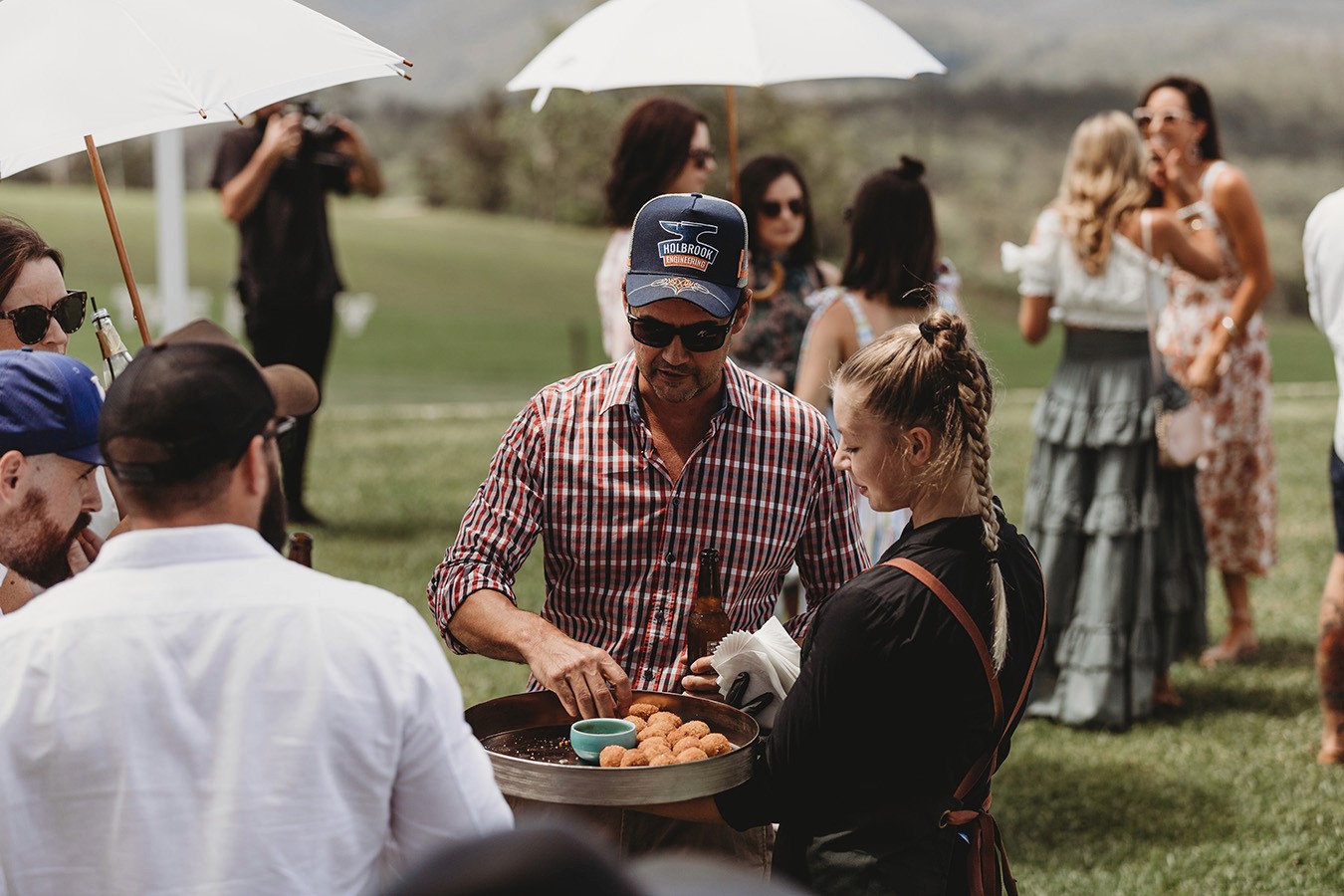
Canapé Service - A particularly good fit for at-home events where guests are moving around rather than seated the whole time, such as a housewarming where people are taking turns touring the house or a gathering that spills out by the pool or into the garden
A Hybrid Approach - A shared main course with a grazing or canapé-style start, which tends to suit how people actually move through a home event
If you're after inspiration, our full menu range gives a sense of what's available across styles, from casual grazing through to more formal plated options.

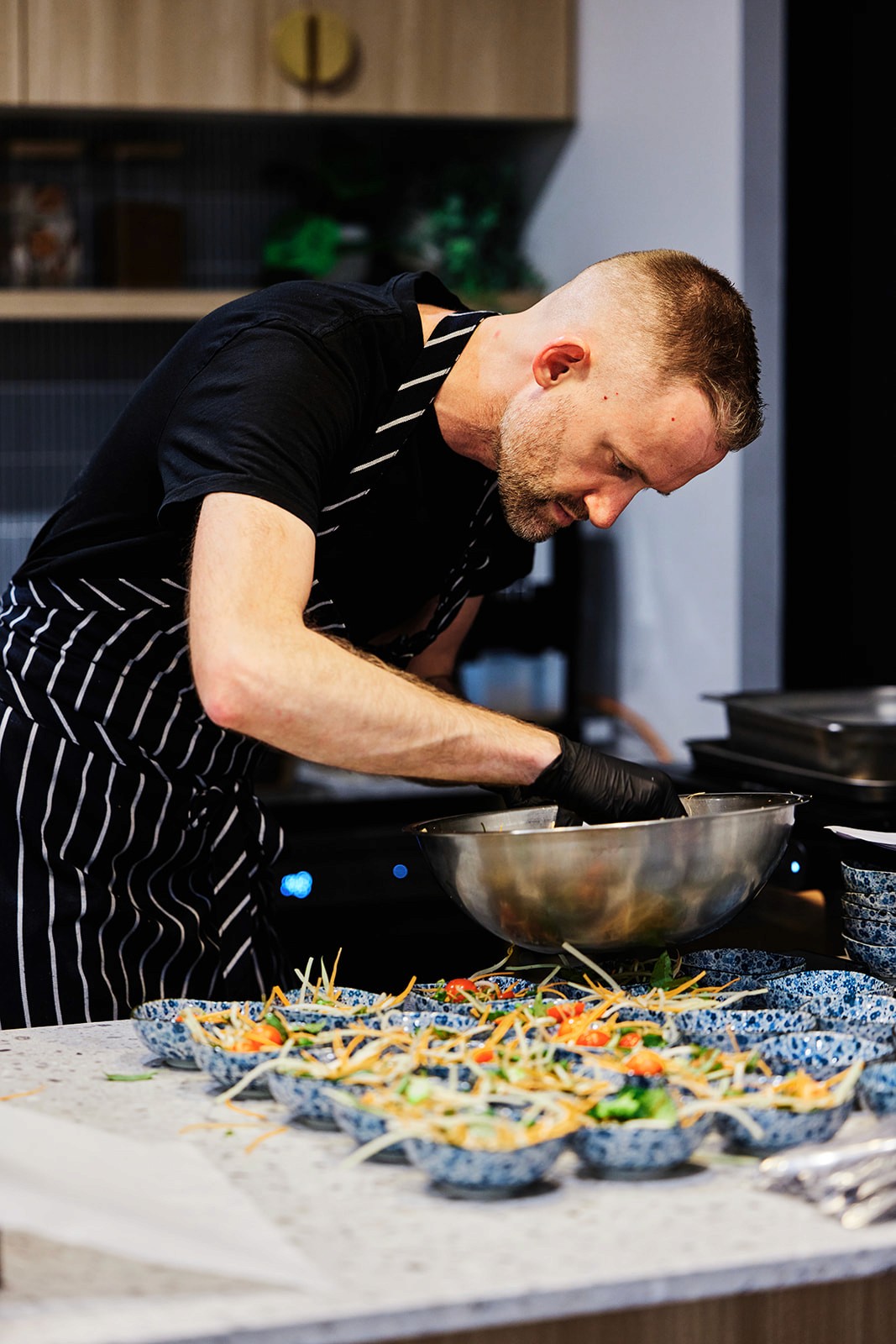
For our private home events, all starting from 20 guests, our minimum recommendation is a team of one waitstaff and one chef, working together to make sure food is prepared quickly, presented well, and served in a timely manner without pulling you away from your own guests.
Past the 30-guest mark, we'll let you know where the team needs to scale to match - whether that's an extra waitstaff member to keep food moving around the room and the service area clean, or an additional kitchen hand to keep turnover on your chosen menu moving at the right pace.
Home events tend to have a more personal guest list than corporate catering, which often means more known dietary requirements and food preferences - we're talking; allergies, cultural or religious dietary needs, or simply "Aunt Karen doesn't eat seafood." Flagging these as early as possible, even informally, lets the menu be built around them rather than adjusted at the last minute. We cover this in more depth in Dietaries & Details: Why They Matter More Than You Think.
Worth keeping in mind too: While we always work to keep whatever kitchen space we're using as clean and contaminant-free as possible, it isn't our own controlled commercial kitchen. If your household regularly has peanut butter in the cupboard and one of your guests has a peanut allergy, there's always some chance of cross-contamination in a home environment - it's important that any affected guests are aware of that going in, rather than assuming a home-catered event carries the same guarantees as a fully controlled kitchen.

A common mistake is treating catering arrival time as the start of the event. In reality, setup, kitchen prep, plating stations, table settings etc.. usually needs 60–90 minutes before guests arrive, depending on menu complexity and group size. Factoring this into your own get-ready time (and any final tidying you're doing yourself) avoids a stressful last hour before guests walk in.
It's also worth knowing that private events rarely run exactly to schedule, and we're used to that. Guests turning up early or running late is common at a home event in a way it isn't at a ticketed function, and if things are tracking well, we can work with you to shift the schedule on the day - i.e. bringing food out a little earlier or holding some back for stragglers, wherever it's practical to do so.
Whether it's an intimate sit-down for 20 or a milestone celebration for 100, our private event catering team will help you build a menu and staffing plan that actually suits your space - not a generic package that assumes you're hosting in a function room.


